
The Black Maternal Mental Health Summit 2026 Is Here. Here Is Why It Matters More Than Ever.
Something is very wrong, and most people are not talking about it.
4 in 10 Black mothers and birthing people will deal with a maternal mental health condition. That is nearly double the rate of all women. But the healthcare system treats Black women at half the rate. Women of color leave more than half of postpartum depression cases unreported. And in this same country, in this same healthcare system, in 2026, Black women die from pregnancy-related causes at 3 to 4 times the rate of white women. Untreated mental health conditions are driving those deaths.
Read that again if you need to.
Think about the woman sitting in a waiting room too long because the system keeps making her wait. The new mother who kept saying she was fine because no one made her feel safe enough to say otherwise. The family that lost someone and still cannot get a straight answer about why the system failed her.
That is the reality this Summit is fighting to change.
The 2026 Black Maternal Mental Health Summit is done raising awareness. We are past that. This year, we are building real solutions, dismantling broken systems, and pulling Black mothers into the rooms where decisions get made.
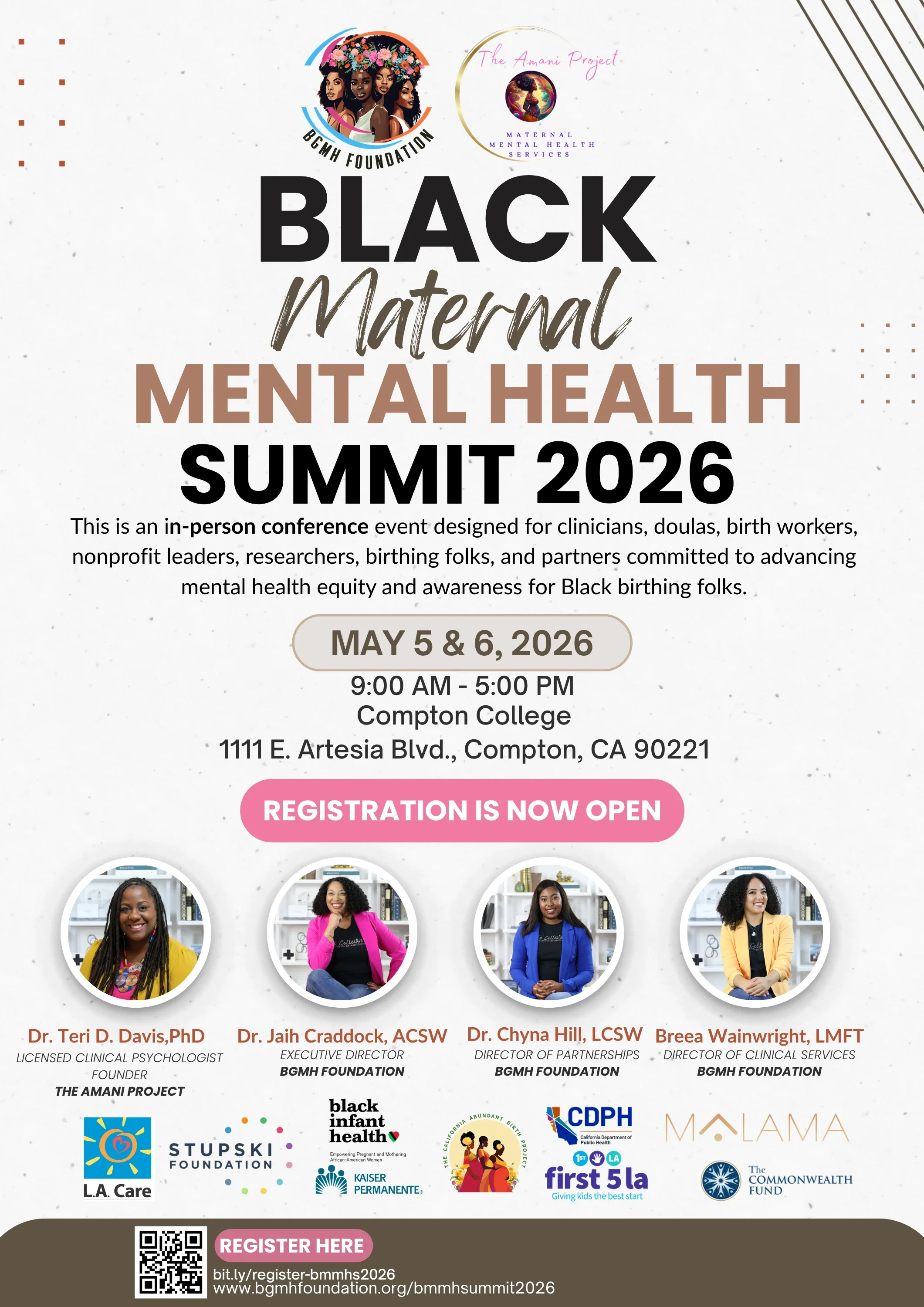
From Awareness to Action
The inaugural Black Maternal Mental Health Summit launched virtually in December 2025. Over 1,000 people registered. Proposals came in from across the country. The average participant rating was 9.63 out of 10. The response was clear: this community has been waiting for a space like this.
But awareness alone was never the goal.
The 2026 Summit builds on that foundation with a sharper focus. This year, the convening moves from raising awareness to building systems. From sharing stories to translating lived experience into practice. From naming the problem to designing the solutions.
On May 5 and 6, 2026, providers, researchers, birth workers, advocates, and Black mothers and families will gather at Compton College in Los Angeles for two full days of learning, strategy, and collective action. A national virtual audience will join from across the country, and a standalone Virtual Community Activation takes place on Saturday, May 10th for those who cannot make it to Southern California.
This is not a conference. It is a field-building movement.
Why This Moment Is Critical
The data is getting harder to ignore. The number of U.S. counties with severe risk for maternal mental health disorders nearly tripled between 2023 and 2025, rising from 24 to 92. Counties in the Deep South, the Gulf Coast, and Appalachia are among the hardest hit. And even as the number of maternal mental health providers doubled over the same period, only 16% of the childbearing population lives in a county with an adequate number of available providers.
Access is not just about distance. It is about trust, culture, and care that actually sees you.
Black women report higher levels of stress at every point across pregnancy compared to women of all other racial and ethnic groups. Structural racism is one of the primary drivers of the gaps in diagnosis, treatment, and outcomes. And recent federal policy shifts, including rollbacks of DEI initiatives, cuts to the CDC's Division of Reproductive Health, and anticipated Medicaid coverage losses, threaten to widen these disparities further at the exact moment we need to be closing them.
The 2026 Summit is a direct response to this moment.
What the Summit Is Built Around
The 2026 convening is organized around three core tracks, each designed to move ideas into action.
Track 1: Coordinated Care and Systems Design This track tackles how maternal mental health services are organized, accessed, and sustained. Sessions explore coordinated entry models, referral pathways, cross-sector collaboration, and the policy and infrastructure changes needed to support Black mothers across the full continuum of care. The goal is simple: reduce fragmentation, improve access, and get to families earlier.
Track 2: Family, Culture, and Community Support Systems Maternal mental health does not happen in isolation. This track centers the role of family, intergenerational trauma, cultural healing, and community-based support in shaping outcomes for Black mothers. Sessions here translate lived experience and cultural knowledge into practical tools that families, providers, and community organizations can actually use.
Track 3: Clinical and Community Innovation in Maternal Mental Health This track is where emerging practice meets real-world application. Culturally affirming clinical interventions, innovative screening and treatment models, workforce development, and the integration of community-rooted healing practices all live here. The question driving every session is the same: how do we improve quality of care and equity for Black birthing people right now?
Who Belongs in the Room
One of the things that makes this Summit different is who it is designed for and who it centers.
This is not a summit for one type of person. It is built for the full ecosystem of care.
Clinicians and therapists will find clinical depth, CEU credits, and practical frameworks they can bring back to their practice. Doulas, midwives, lactation consultants, and birth workers will find sessions that honor the full spectrum of the maternal care team. Researchers and advocates will find a platform for ideas that translate into systems change. And Black mothers and birthing people will find a space that was built with their voices, their experiences, and their healing at the center.
Free admission for Black mothers and birthing people is not a footnote. It is a design choice. It reflects what the Summit believes: that the women most affected by these disparities should be in the room where the solutions are being built.
A Two-Day Experience Worth Showing Up For
The Summit is not a passive experience. Every element of the program is designed for engagement.
Day one opens with a keynote address and moves into expert panels spanning maternal health, reproductive justice, and community advocacy. Breakout workshops give attendees practical tools they can apply in their practice or community the next day. Wellness experiences, including movement, breathwork, and reflection spaces, are woven throughout so that healing is not an afterthought.
Day two includes more clinical and community sessions, a curated vendor marketplace featuring Black-owned maternal wellness brands and community organizations, and a community baby shower for Black mothers and birthing folks with resources, gifts, and celebration.
The Compton College Farmers Market is on campus on May 6th, connecting the Summit to the everyday life of the neighborhood that is hosting it.
For providers attending in person, 6 APA-approved continuing education credits are included. Most licensing boards, including LMFTs, LPCCs, LCSWs, and LEPs, accept APA-approved CEUs.
The Bigger Picture
The Summit does not exist in isolation. It is part of a longer vision.
The Black Girls Mental Health Foundation was built on the belief that Black women deserve care that honors their voice, their history, and their humanity. The Summit is one of the most visible expressions of that belief, a national stage for the clinicians, researchers, advocates, and mothers who are doing the work every day to close the gaps.
Over 150 proposals were submitted for 2026. That number tells its own story. There is no shortage of people ready to show up, to share what they know, and to build something better together.
This is what a movement looks like in practice.
Join Us
The 2026 Black Maternal Mental Health Summit takes place May 5 and 6 at Compton College in Los Angeles. The Virtual Community Activation takes place Saturday, May 10th via Zoom.
Registration is open now.
Black mothers and birthing people attend for free. Providers and clinicians register at $250, which includes 6 APA-approved CEUs, meals, and a swag bag. Student tickets are available at $100.
Register here: https://bit.ly/register-bmmhs2026
If you cannot attend but want to support the work, sponsorship opportunities are available at multiple levels. Contact drhill@blackgirlsmh.org to learn more.
And if you know someone who needs this space, please share this post. Forward the flyer. Tell a colleague. Tell a friend.
The more of us in the room, the stronger this work becomes.