
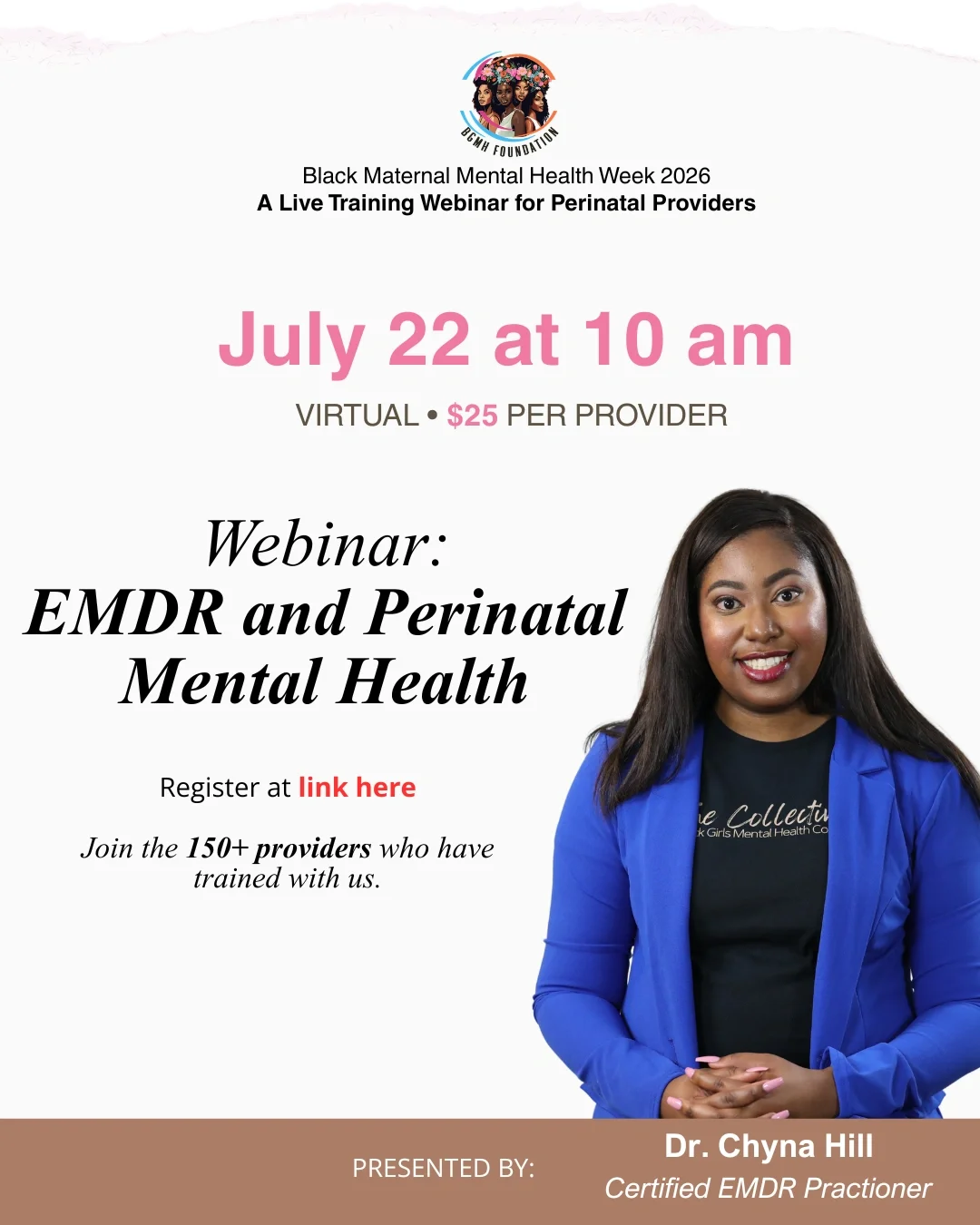
A clinical tool for a trauma most providers were never trained to spot.
Presented by Dr. Chyna Hill, LCSW, PMH-C, and Certified EMDR Practitioner, this webinar looks at how EMDR (Eye Movement Desensitization and Reprocessing) can be used to treat trauma connected to pregnancy, birth, and the postpartum period. Birth trauma doesn't always look like what providers expect, and it doesn't always get named as trauma at all.
Wednesday, July 22, 2026, 10:00 AM PST, 60 minutes, $25 per provider
For many Black women, trauma in the perinatal period isn't a single event. It's the accumulation of being unseen, unheard, and unsafe: chronic dismissal in medical settings, a traumatic birth, the gap between the birth that was planned and the one that happened. Talk therapy alone often doesn't reach where this trauma actually lives, which is the body. This session introduces EMDR (Eye Movement Desensitization and Reprocessing) as a body-based, evidence-based approach to healing perinatal and birth trauma, not just managing its symptoms. You'll learn what EMDR is and how its 8-phase protocol works, why it doesn't require detailed verbal disclosure of trauma, and why that matters for Black women who've had the experience of not being believed. We'll also cover the evidence base for EMDR in birth trauma, how EMDR Intensives create faster access to relief for patients who can't sustain weekly therapy, and a practical framework for knowing when a patient is ready for EMDR versus when stabilization needs to come first. You'll leave with a hands-on grounding tool (the butterfly hug) you can teach patients immediately, language for screening explicitly for birth trauma, and a clear picture of how to identify and refer to qualified, EMDR-certified providers. By the end of this session, you'll be able to:
Explain what EMDR is and how bilateral stimulation supports trauma reprocessing
Recognize birth trauma and postpartum PTSD presentations that talk therapy alone may not resolve
Apply a clinical framework for determining EMDR readiness versus the need for stabilization first
Screen for birth trauma explicitly, not only postpartum depression
Identify credentials (EMDR-certified, PMH-C, licensure) that distinguish qualified EMDR providers
Teach a self-administered bilateral stimulation technique to patients the same day This is a conversation, not a lecture. Expect interactive moments, discussion prompts, and live Q&A throughout.